Projects
Research Projects
DeCLIC: Describing Cross-Linguistic Imagery and Convention
Combining conventional schemas and creativity in the depiction of events from an external perspective in LSFB and Belgian French
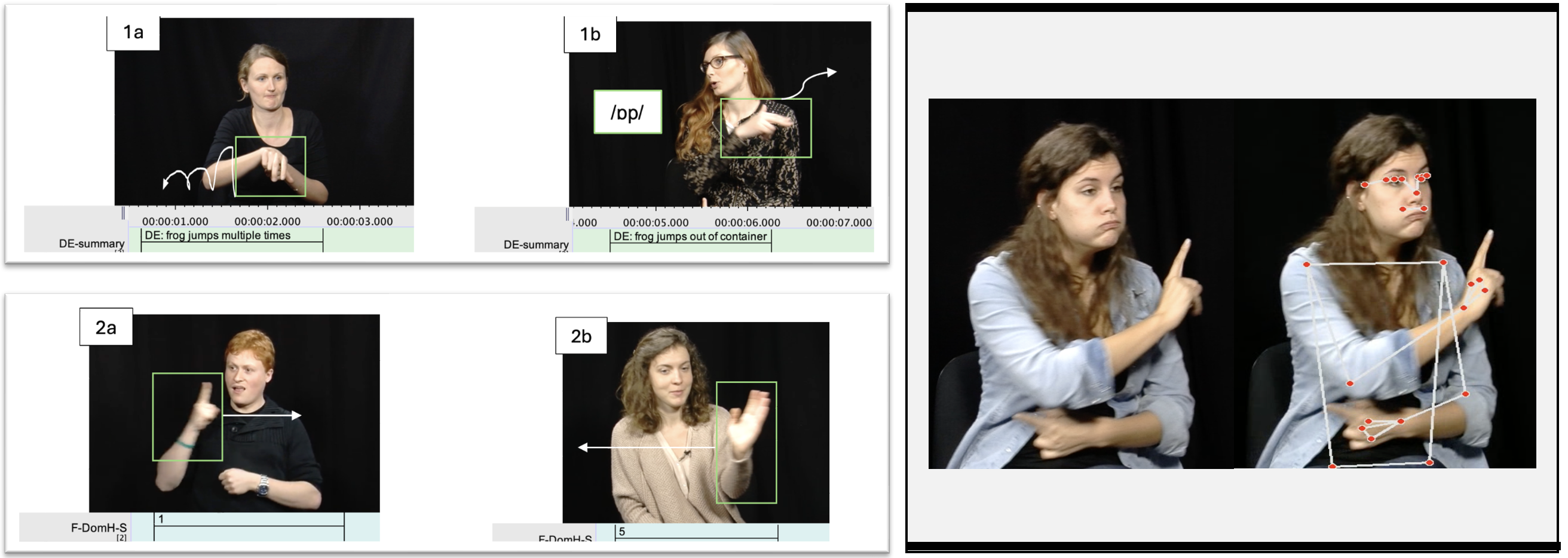
Oct. 2025 – Sep. 2028: PI: Sébastien Vandenitte, Supervisor: Laurence Meurant (UNamur), funded by the Fund for Scientific Research – FNRS (Postdoctoral researcher grant)
This project aims to study how LSFB signers and Belgian French speakers make use of improvised and conventional iconicity when showing events from an external perspective. It focuses on novel depictions as well as on iconic signs and words in LSFB and French, asking how these lexical items can be recruited into depictions and manipulated across different language tasks of the LSFB and FRAPé corpora.
ShowTell: Motion capture work package
Showing and Telling in Finnish Sign Language
Oct. 2023 – Aug. 2025: PI: Tommi Jantunen, funded by the Research Council of Finland
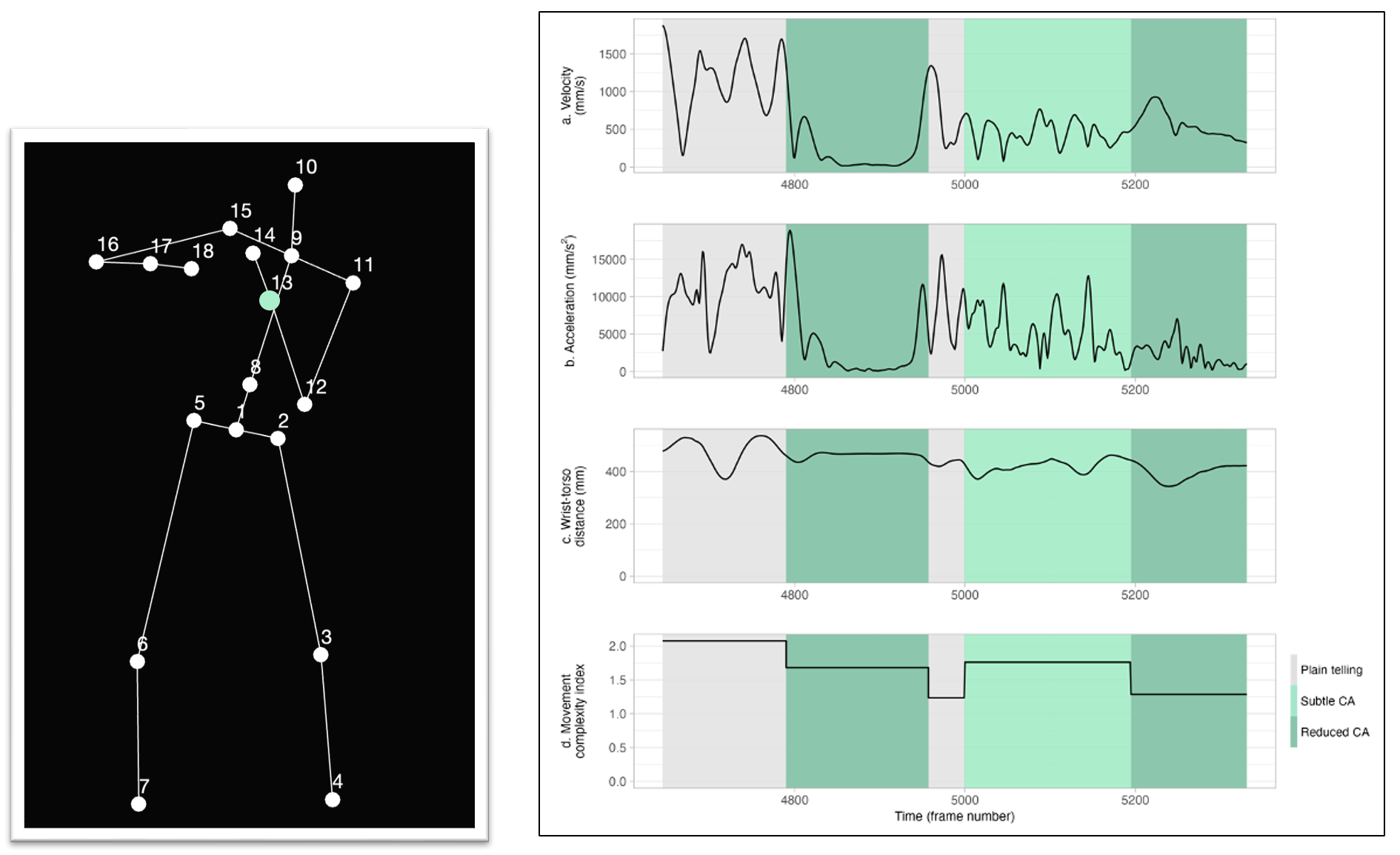
I was responsible for the ‘motion capture’ work package of the ShowTell project (Research Council of Finland, University of Jyväskylä). Together with Anna Puupponen, Doris Hernández, Benjamin Anible, and Tommi Jantunen, we looked at how FinSL signers’ hands move when these signers are not enacting referents and when they’re enacting referents to different degrees. To do so, we combined manual annotations in ELAN with motion-capture measurements. What we found was that FinSL signers' moved their hands more (read: they had higher velocity, acceleration, complexity and moved further away from the body) when they were not enacting and moved their hands less when they used stronger constructed action.
Constructed Action in LSFB and Belgian French: Making Referents Seen and Heard
Comparing LSFB signers' and Belgian French speakers' constructed action practices
Oct. 2019 – Sep. 2023: PI: Sébastien Vandenitte, Supervisors: Laurence Meurant (UNamur) & Philippe De Brabanter (ULB), funded by the Fund for Scientific Research – FNRS (Research Fellow grant)
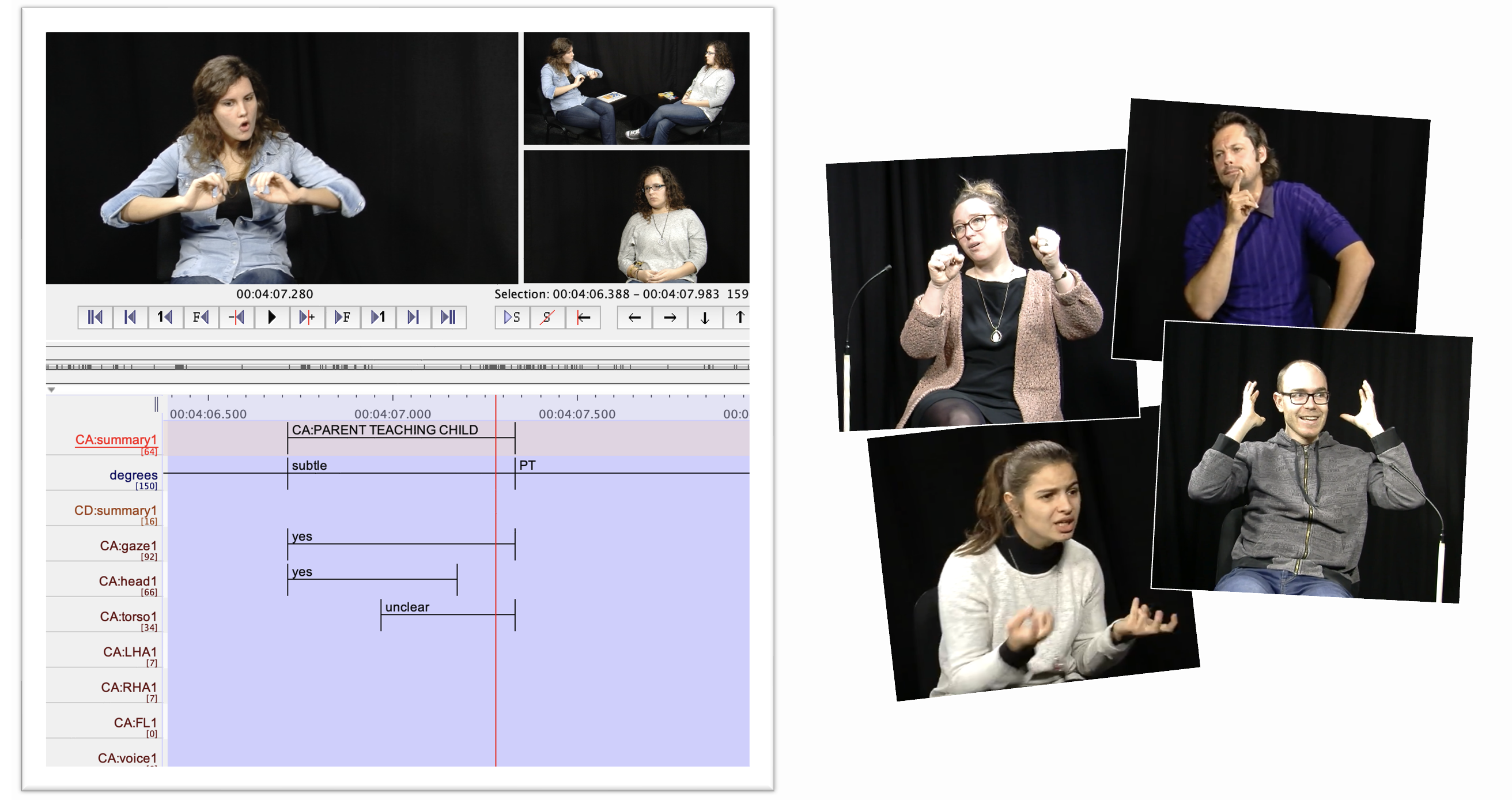
This project is based on annotations carried out in the directly comparable corpora: LSFB and FRAPé. These annotations led to the following main results:
• Both LSFB signers and French speakers use their bodies to depict people or things they refer to, though with a lower frequency in French. Both groups adapt their use of CA to the language task at hand: less CA in a conversational setting, more CA in elicited storytelling.
• LSFB signers and French speakers use an overlapping set of bodily articulators to enact referents, like their head and gaze behaviour. Some differences were found too: LSFB signers used facial expression a lot, unlike French speakers. French speakers used their hands a lot, which LSFB signers did less.
• LSFB signers used stronger forms of CA (reduced and overt CA) in a storytelling context than in conversations. In their stories, LSFB signers and Belgian French speakers performed CA with different degrees: LSFB signers used stronger forms of CA. French speakers mostly used subtle CA.
Associated publications
Vandenitte, S. (under review for Open Linguistics). Calibrating degrees of constructed action: A corpus-based comparison of LSFB and Belgian French conversations and narratives.
Vandenitte, S. (2024). Making Referents Seen and Heard: Comparing constructed action practices in LSFB (French Belgian Sign Language) and Belgian French. PhD Thesis manuscript.
Vandenitte, S. (2023). When referents are seen and heard: A comparative study of constructed action in the discourse of LSFB (French Belgian Sign Language) signers and Belgian French speakers. In L. Gardelle, L. Vincent-Durroux, & H. Vinckel-Roisin (Eds.), Studies in Language Companion Series: From conventions to pragmatics (pp. 127–149). Studies in Language Companion Series; Vol. 228.
Vandenitte, S. (2022). Making referents seen and heard across signed and spoken languages: Documenting and interpreting cross-modal differences in the use of enactment. Frontiers in Psychology, 13, 784339.
Vandenitte, S. (2022). Showing where you stand: The depictive potential of the lexical sign LS in LSFB conversations about language attitudes. Belgian Journal of Linguistics, 36(1), 46–72.
Vandenitte, S. (2021). Construire l’action pour rendre les référents visibles en LSFB: Une étude pilote des mouvements corporels dépictifs. In S. Vandenitte, A. Lepeut, & L. Meurant (Eds.), Travaux du Cercle belge de linguistique (Vol. 15).
Vandenitte, S. (2019). Une approche pragmatique du transfert personnel en langues des signes: La construction du discours et de l’action à visée illustrative. In C. Béchet, L. Brems, & M. Steffens (Eds.), Travaux du Cercle Belge de Linguistique (Vol. 13).
Datasets
The FRAPé Corpus
A Multimodal Corpus of Belgian French
2018 - ongoing
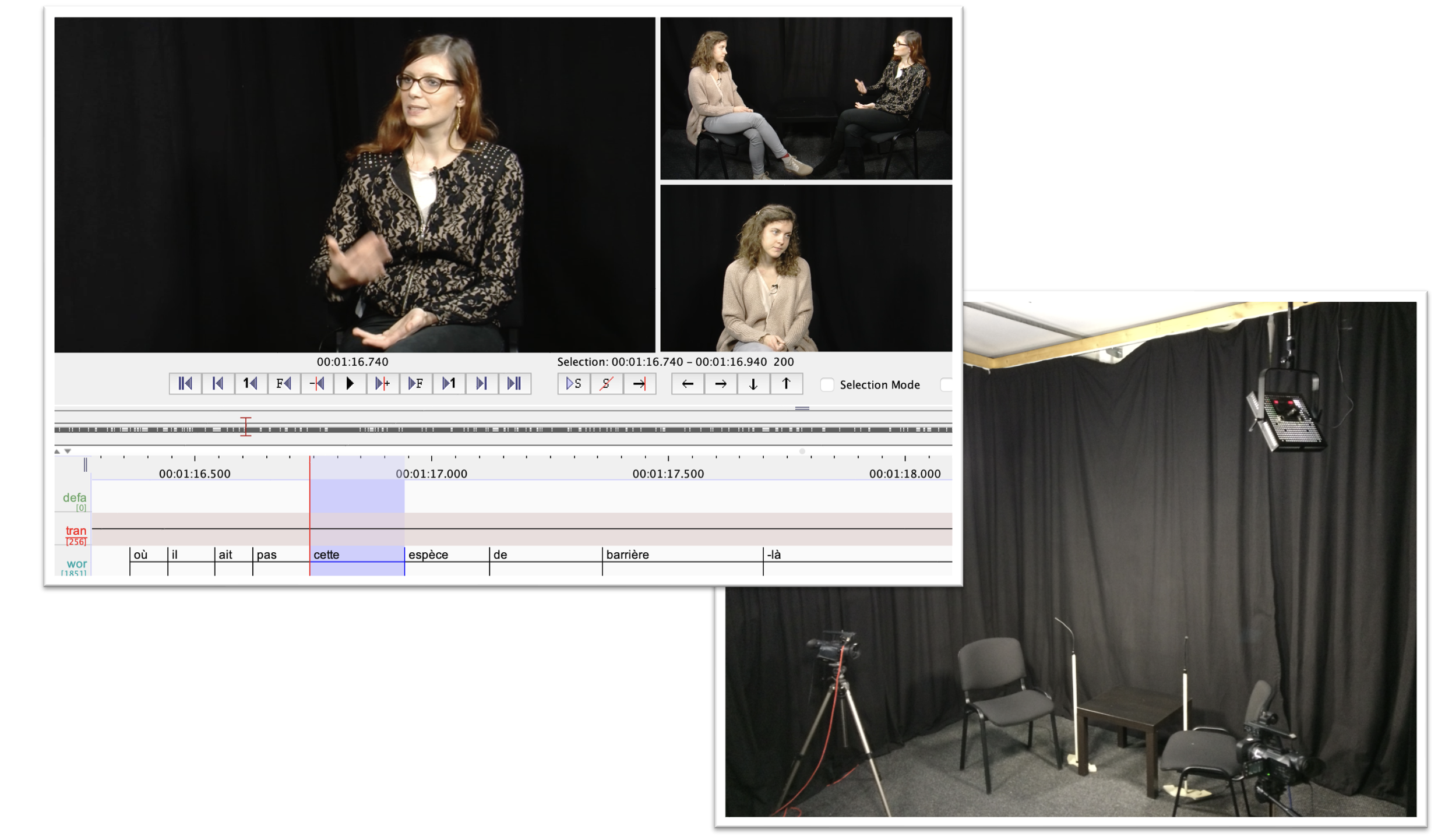
Together with several colleagues (Alysson Lepeut, Clara Lombart and Laurence Meurant) at the University of Namur, we are building a multimodal corpus of Belgian French dyadic interactions. This unique dataset puts French speakers’ gestures and body in the spotlight. In addition, it is also directly comparable with the LSFB Corpus (published by the LSFB-Lab in 2015). The data collection for the FRAPé Corpus is still ongoing but the existing data has already enabled several studies.
Associated publications
Lepeut, A., Lombart, C., Vandenitte, S., & Meurant, L. (2025). Make it a Double: The Building and Use of the LSFB and FRAPé Corpora to Study and Compare French Belgian Sign Language and Belgian French. In T. Leuschner, A. Vajnovszki, G. Delaby & J. Barðdal (Eds.), How to Do Things with Corpora: Methodological Issues and Case Studies on Grammar (pp. 31-64). J.B. Metzler, Berlin, Heidelberg.
Lepeut, A., Lombart, C., Vandenitte, S., & Meurant, L. (2024). Spoken and Signed Languages Hand in Hand: Parallel and directly comparable corpora of French Belgian Sign Language (LSFB) and French. Corpora, 241–253.